


Get to
Know Me
Hey there!
I'm Jyle, the social media marketer and community manager you've been looking for! Throughout my student life, I have taken various roles (a student leader, a student film director, an active community involvement member, to name a few), but two things have always been constant: my love of interacting and socializing with people and creating content through writing.
As a young girl, I have been very shy, but with my exposure through being a student leader, I have learned to love the art of socializing and creating connections. Over the years, I have honed my passion in reading into putting my imagination to words through writing stories and poems, which later, also evolved to writing feature articles for our school paper.
With all these things combined, I eventually took up a course that incorporates both of these passions, Corporate Communications. Pair that with prior experiences in working as an office staff for a realty agency, as well as earning an internship for community management at a digital transformation agency, and you've got me in a nutshell.






Reasons Why Meme Marketing
Might Be Your Next BIG Move
Nowadays, memes can be found whenever we look through social media. They can be shared as a joke, anecdote, and, more recently, as a social media marketing tool. Due to their popularity, particularly among younger generations like gen Y and gen Z, memes have become a useful strategy for attracting social media attention. hkkhh
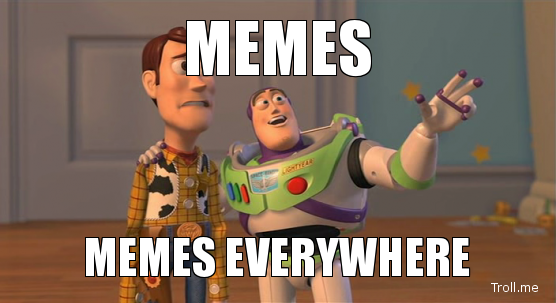
Memes serve a wide range of purposes and functions, but at its essence, they serve as an expression of people's thoughts and feelings. They may be created by lifting dialogue or sequences from movies and TV shows, taking them out of context, mixing them with new content, and giving them amusing, and relatable twists. Meme content may range from the challenges and struggles of being a student to expressing embarrassment after an incident in a person's daily life—simply put, it is a type of content that everyone can resonate with.
However, before we dive into the world of memes, let us first explore the history of how this word came to be. The term "meme" was first used in 1976 by evolutionary biologist Richard Dawkins to describe how concepts, behaviors, or trends spread from one person to another within a society. He coined this phrase in his book, The Selfish Gene. (and yes, it was written waaaaay before the internet was even a thing!) But, it wasn’t until in 1994 when Mike Godwin conceptually introduced memes in popular culture through his article in Wired Magazine, and 2 years later, in 1996, memes began to go digital as graphic designer, Michael Girard created one of the first digital memes, Baby Cha-Cha-Cha or now more popularly known as the Dancing Baby.

Still, it was ultimately in the millennium year, 2000, when meme templates began to go viral as pictures with superimposed texts were created. It was from that year and up until today wherein the use of memes did not only go mainstream, but has also evolved into more diverse content that people still continuously enjoy and relate to.
Sure, a picture may paint a thousand words, but memes are just so priceless. It has come to the point that people have been wondering how memes impact communication as memes have become more prevalent in our digital vocabulary. On one hand, memes promote establishing significant connections within the online community since they are generally understood by many individuals worldwide, regardless of their native context.
On the other hand, as memes simplify everything to one-liners and photos, it is undeniable that they may make communication more difficult. Sometimes they can be used to incite misunderstanding and prejudice toward specific racial groups, genders, religions, or sexual orientations, dividing people rather than uniting them.
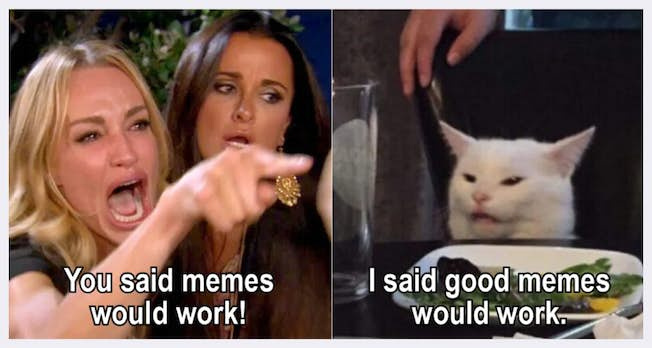
Memes have transformed the way we communicate, however, the instant power of a meme to be shared with millions of people online can only serve to further advance a different approach of thinking in our culture. And, while many individuals enjoy anonymity on the web, it has been attested several times that incorrect behavior online may have a lasting impact on a person's life. Therefore, it is still crucial to consider your actions before clicking.
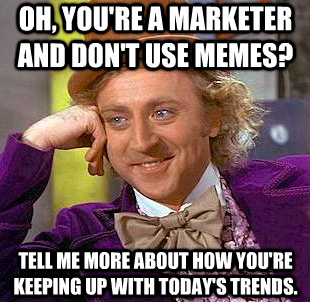
Indeed, the simple act of spreading memes, posting them on social media, and tagging friends in certain meme content pages on social media has become a quick and entertaining way for individuals to interact with one another, whether they're used to express their opinions about certain socio-political matters or to justify their obsessions with well-known celebrities. And this too, has helped improve communication around the world and enabled globalization to thrive.
So, now, given the context, you may start to ask, how do memes fare as a new media marketing tool?
When used wisely, memes are an excellent complement to any social media post. Thus, here are 4 major reasons why using memes in your brand's marketing might be your next BIG move:
MEMES ARE FUN
It's simple to make someone's day better by sharing a goofy GIF, a witty photo, or a hilarious video when browsing any social networking website. Plus, they could be the perfect medium for a message of inspiration or motivation.
MEMES ARE DIVERSE
Meme content may be found in a wide range of media types, including text, images, videos, GIFs, and audio recordings. Thus, it's no surprise that a single meme content can produce thousands of memes featuring different contexts, but the challenge lies in finding the perfect caption for it, too!
MEMES ARE POPULAR
Many memes make use of pop culture references and hot topics as their compelling strategy to bring people together and build a sense of community through these shared experiences. Thus, more than just creating a meme, you must always be aware of what is going on in and out of social media.
MEMES ARE RELATABLE
Memes are a fun way to add some personality to your social media presence. In a sea of tastefully curated brand posts, your audience may find it refreshing to connect with genuine feelings. It makes your audience feel that they are not alone and realize that more than being just a brand, you also understand them.
Utilizing a popular meme template that has already gone viral can enhance the likelihood that your meme content can grab the attention of your target audience, followers, and buyers, even if it doesn't become viral. However, to get the most out of meme marketing, your social media team must meticulously plan out each meme content. Truly, memes are a great way to engage people, broaden your audience, and boost branding efforts when used as part of social media marketing campaigns.
Unlocking the Power of Communication
The ever-changing business and communication landscape emphasizes the importance of a communication manager. These knowledgeable individuals are tasked with developing and implementing communication strategies that effectively communicate a company's message to its various stakeholders. Their duties, however, go beyond simply disseminating information; they also include fostering relationships with colleagues, clients, and the public in general.
In this interview with one of Solo Analytica's Head Managing Partners, Janra Avissa Gimenez, we delve into the life, philosophy, and management style of a communication manager, exploring the complex fusion of competencies, strategies, and guiding principles that strengthens her work; emphasizing the harmony she achieves between effective communication and compassionate leadership.
Janra's journey towards becoming a successful business manager began with her background in marketing and sales. When the pandemic hit, she decided to take on freelance marketing work for various companies to expand her portfolio. Eventually, she hired two employees to help with her workload.
As time passed, Janra met two potential business partners through mutual friends. Together, they founded Solo Analytica, a marketing company that specializes in e-commerce, back-office solutions, and digital marketing services.
Janra's role as a head managing partner of Solo Analytica Solutions is a demanding one. She is the primary decision-maker responsible for overseeing day-to-day operations, managing clients, budgeting, and sales. Together with her partners, she makes critical decisions to ensure business growth and success.
As the head of operations, Janra is accountable for team progress, company development, and resolving client issues. With over sixty employees, most of them under her wing, her role requires perceptive leadership and the ability to balance multiple responsibilities at once. Despite these challenges, Janra's commitment to her work and prior experience has provided her with a solid foundation, allowing her to quickly adapt and learn the necessary skills and apply them in her work endeavors.
Janra recognizes that communication is a two-way street, and as a business owner and managing partner, she understands the importance of effective communication in cultivating growth, avoiding misunderstandings, building strong relationships, and fostering trust. However, despite her efforts to ensure effective communication, barriers still exist, such as information overload, restricted channels, lack of feedback, and a culture of not asking questions.
To counter these barriers, she has assigned project managers and department heads to communicate with employees and clients through various communication tools. She believes that this targeted approach allows for better problem identification and understanding.
Nevertheless, Janra encountered a communication breakdown when an international client had problems with their Google and Facebook Ad Analytics, which were not reported to her for more than a week due to a personal issue experienced by her department head. As Janra is meticulous with her work, she sensed that something was amiss and reached out to the client for feedback. From there, she took over the project until the department head returned to the office.
Janra's commitment to effective communication extends to creating a safe space for everyone at work, encouraging employees to communicate with her directly at any time and being transparent about personal issues that may impact their work. She also regularly requests feedback from project managers and department heads and receives weekly reports to stay up-to-date with the workforce, outputs, and clients. Despite the barriers to communication, Janra remains determined to foster a culture of effective communication that promotes growth and collaboration within her team.
When asked about the pressures of her work, Janra shares that she faces significant pressure in her role, juggling day-to-day operations, clients, budgets, and personal relationships, all while prioritizing her physical and emotional well-being. Despite these challenges, she remains committed to setting a positive example for her team. As a compassionate and effective manager, she understands that demonstrating discipline, control, and delayed gratification are key to success.
Her employees are her number one priority, recognizing that they are the key to her company's growth. She acknowledges that everyone experiences ups and downs, but as a leader, she must show up at work looking strong, happy, and motivated, even on her worst days.
Janra hopes to inspire her team to persevere through difficult times and to continue to work towards their goals. For her, the reward is not just in achieving success, but in knowing that she has helped her team grow and develop along the way.
Get in Touch
Reach me by clicking on these social media platforms!
Scan the QR Code to send me a message!
